
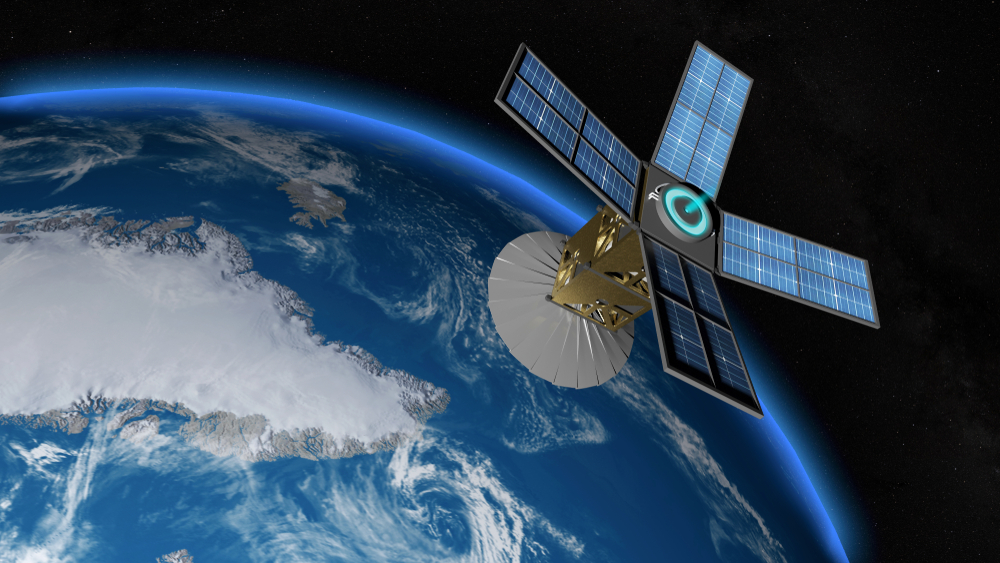
When Sputnik 1, the initially satellite, was launched by the Russians in 1957, very low Earth orbit was a lonely spot. Today, just six a long time later on, the room all around Earth appears to be considerably various. Hundreds of satellites whiz all around our world at varying altitudes at speeds approaching 20,000 miles for each hour. Of the far more than eleven,000 satellites that have at any time been launched, there are approximately three,000 presently active, according to the Union of Worried Scientists’ Satellite Database.
That amount could pale in comparison to the satellite populace by the end of the ten years, although. Some estimates present that far more than a hundred,000 satellites could orbit our world by 2030, an exponential boost that has several researchers anxious.
The steep increase in satellite quantities will probable come mostly from so-referred to as satellite constellations, teams of dozens or even hundreds of small satellites united in a common job. The most effectively-identified of these is probable SpaceX’s Starlink constellation, which delivers world-wide-web entry to distant areas. The corporation has about 1,500 satellites presently in orbit, and founder Elon Musk options for tens of hundreds just one working day.
They’ll share room with satellites from dozens of providers and nations, set there to help communications, give climate info, choose pictures, carry out experiments and far more. These satellite swarms could convey world-wide-web entry to distant villages, help researchers to hold tabs on local weather alter with new precision and far more. But they could also interfere with astronomers’ capacity to look at the evening sky, and pose new hazards to manned missions to room. House is unquestionably likely to get far more crowded soon — the results of which will remain to be observed.
Far more Satellites Are Greater
There are two factors probable to travel the explosion in satellite quantities. A single is the arrival of private spaceflight providers, which have supplied the rockets needed to convey big quantities of satellites to orbit. The other is CubeSats, small, modular satellites that are much less expensive to develop, and simpler to choose to orbit than common custom-created satellites.
Because they are small, it prices considerably considerably less to choose a CubeSat weighing potentially a handful of dozen pounds to orbit than a much larger satellite weighing about a thousand pounds. And CubeSats, compared with created-to-buy satellites, can be created rapidly and far more cheaply. People charge efficiencies have created it feasible for providers like SpaceX to envision generating and launching hundreds of satellites in just a handful of a long time.
Satellite swarms present a handful of essential benefits about common satellites, particularly for communications and world-wide-web entry. Commonly when a satellite orbits Earth, it need to go exceptionally rapidly, indicating it will not keep in selection to deliver, say, broadband for long. Geostationary satellites clear up this challenge by orbiting accurately as rapidly as the Earth does, but the tradeoff is that they need to remain pretty considerably away: 22,236 miles vs . a handful of hundred for very low Earth orbit. That means transmissions choose considerably more time and require far more ability — not excellent when you’re hoping to make certain rapidly world-wide-web entry.
But a constellation of several satellites can keep in very low Earth orbit while ensuring that just one or numerous of its associates is in selection of ground-primarily based transmitters and receivers at all periods. That means the constellation can converse to, or hold an eye on, the very same areas on Earth at all periods. With enough satellites, the constellation could achieve just about every level on the world 24/7 — the top objective of several satellite constellation suppliers.
Sharing Lower Earth Orbit
The initially satellite constellations essentially date back again a long time. The World-wide Positioning Procedure, or GPS, relies on a community of at least 24 satellites orbiting Earth, taken care of by the U.S. government. Today, every thing from smartphones to mapping applications to monetary systems rely on GPS to work. Very similar systems, like the European Union’s Galileo Network and Russia’s GLONASS also rely on their possess teams of satellites. On the commercial side, the privately-owned Iridium community of 66 spacecraft has been providing satellite cell phone protection for far more than two a long time.
Today, several of the satellites in orbit are associated in communications. That holds accurate for satellite constellations as effectively, several of which are aimed at providing world-wide-web entry, à la Starlink. Europe’s O3b commenced providing satellite world-wide-web to purchasers in 2014 working with its possess community of spacecraft. OneWeb, which has partnered with Airbus, options to launch a full of 900 satellites in coming a long time to flesh out its possess world-wide-web community. China, in the meantime, a short while ago introduced options to set some thirteen,000 satellites in room to create its Gouwang world-wide-web system.
But it is not all about the world-wide-web in room. San Francisco’s Planet Labs is working with approximately 200 Dove satellites to continuously photograph the total world. These images enable them to give photographs of Earth’s floor at three to 5 meters resolution, current many periods a working day in some conditions, the corporation states. They’re aiming to nab purchasers in industries ranging from agriculture to study to infrastructure.
Spire, a further imaging and room-primarily based checking corporation, offers solutions like ship and aircraft monitoring and climate checking working with its proprietary satellite community. GHGSat’s satellites track emissions on Earth, hunting for methane leaks and other sources of greenhouse gases. The corporation hopes to have ten satellites in orbit by the end of 2022.
An additional corporation, Cloud Constellation, is trying to clear up a further challenge completely. The startup hopes to influence providers to keep their info in orbit, in servers aboard its satellite swarm.
Hazards of Achieving for the Stars
An exponential boost in the amount of steel packing containers flying by means of around-Earth room poses a amount of pitfalls, some far more noticeable than other individuals. Some come from astronomers, who get worried that swarms of satellites will interfere with their observations of deep room.
People worries have been set on screen practically instantly right after SpaceX commenced launching Starlink satellites to orbit. A photo taken at the Lowell Observatory in Arizona in May possibly 2019 reveals dozens of brilliant streaks obscuring the sky as Starlink spacecraft flew overhead. The photo is a little bit of an exaggeration, as the satellites continued to spread out right after launch. But it could be a harbinger of the crowd to come.
Far more satellites could also signify far more radio frequency transmissions flying about the environment. In addition to looking noticeable light, astronomers keep track of the sky throughout considerably of the electromagnetic spectrum, which includes in radio frequencies. Radio waves can journey by means of issues that block light, like dust, indicating astronomers can see issues if not obscured. Visuals of new galaxies, pulsars, quasars, and even the initially-at any time picture of a black hole have come many thanks to radio telescopes.
Far more satellites in orbit also boosts the odds of collisions. Two spacecraft smashing into each other at speeds of tens of hundreds of miles an hour may possibly direct to the dreaded Kessler Syndrome, a feedback loop of destruction that could render Earth orbit a no-fly zone for a long time. The procedure is simple: An original collision generates a cloud of hundreds of pieces of particles whipping all around the world. Some of these pieces strike other spacecraft, generating far more particles, and the end result is a cascade of satellite mayhem. The ensuing cloud of particles may possibly be dense enough that any spacecraft set into orbit would be ruined, putting a untimely end to the satellite era.
That eventuality could be averted by ongoing endeavours to thoroughly clean up very low-Earth orbit, wherever an approximated 12,000 trackable pieces of particles by now circulate. Some of individuals are from earlier satellite mishaps, this sort of as the 2009 collision amongst a defunct Russian satellite and an Iridium satellite. Although the odds of a spacecraft remaining destroyed by particles remain slender, it is even now lead to for caution. The Worldwide House Station has been moved on many instances to limit the possibility of remaining strike by close by objects.
And far more satellites above us could end result in variations to our world, also. A the latest review estimates that Starlink’s satellites by itself may possibly convey far more aluminum into the higher environment on re-entry than meteoroids do. That further steel may possibly destruction the ozone layer, some researchers speculate, even further harming the surroundings. It’s a reminder of just one of the basic principles of satellite procedure: What we set up into orbit will someday come back again down to Earth.
About the Author

