
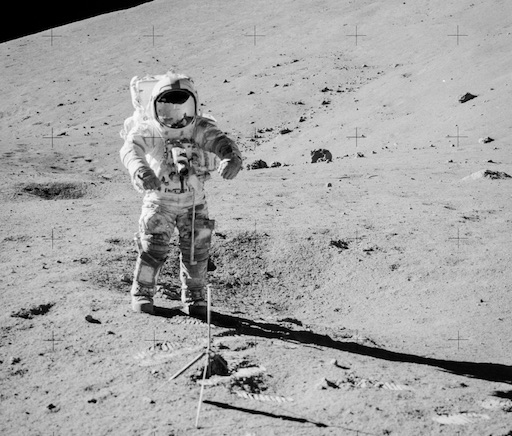
In 1972, when geologist and Apollo 17 astronaut Harrison Schmitt noticed a patch of strange orange soil on the moon, he understood it was special, but he was not confident exactly why. “Until it was probable to appear at this product in the laboratory below high resolution and analyze it, we did not know that we experienced discovered a deposit of volcanic ash,” he says.
Fifty yrs afterwards, Schmitt even now is not conscious of all the discoveries his mission will generate. Which is because researchers in the Apollo Subsequent Generation Sample Assessment (ANGSA) plan are only a short while ago commencing to examine lunar samples that had been saved for future researchers. Their initiatives purpose to remedy important concerns about the moon’s past and, as the Artemis software prepares for launch in the subsequent few decades, lunar exploration’s future.
Properly Preserved
Apollo 17’s sample 73001, which was gathered from a pile of particles deposited by a lunar landslide, will be opened for the first time in the coming weeks, says ANGSA researcher Charles Shearer, a investigation scientist at the University of New Mexico and a traveling to researcher at the Lunar and Planetary Institute. This sample was saved in a Main Sample Vacuum Container (CSVC), an elaborate air-tight equipment whose penetration has been plotted for more than a calendar year. Sample 73001 is particularly valuable simply because it has been sealed in these types of a pristine point out, Shearer suggests. “Many of the other Apollo samples may perhaps have experienced different amounts of contamination from Earth, so we lose aspect of the lunar fingerprint,” he says.
Schmitt, who is actively included in the ANGSA software, feels “admiration for the individuals 50 several years back that made the decision to preserve a couple of the samples in anticipation of the technological know-how advancing noticeably more than time.” Making use of modern day resources to evaluate 73001 will present both information and working experience dealing with lunar samples that will reward upcoming missions, he states.
Schmitt and Shearer will assistance measure 73001’s lunar volatiles — very easily vaporized chemical aspects that are embedded into the moon’s soil. Employing a fairly new strategy that identifies each compound in a product by its mass, the team can evaluate the risky things and additional compounds that decay above time in the sample. Collectively, this knowledge offers clues as to when and how the landslide happened — for illustration, whether or not it was caused by a seismic or an impact party. Solving the landslide mystery could also help forecast the safety of human settlement on the moon, Shearer states. “Are there going to be any form of tectonic- or earthquake-related activities that could threaten human routines on the moon?” he states. “Perhaps this will drop some light on that.”
Seeking Inward
The scientists are also interested in comprehending how lunar volatiles can be employed as a resource to support human existence on the moon. “In the earlier, when Apollo went to the moon, we took anything with us,” Shearer says. Ultimately, nevertheless, astronauts could possibly be able to “partially stay off the land” when discovering and even venturing outside of the moon, he suggests. For example, hydrogen and oxygen provide as the constructing blocks of h2o, and hydrogen and a gentle model of helium might be applied as a rocket fuel source to ability more room travel.
A different ANGSA crew is led by Darby Dyar, a professor of astronomy at Mount Holyoke School who researched the orange soil sample as a graduate pupil. As an ANGSA researcher, she is characterizing volcanic glass beads in other samples to greater have an understanding of the composition of the lunar interior. These pyroclastic eyeglasses, which are smaller sized than a grain of salt and make up about 20 % of the soil on the moon, shoot out from the lunar inside throughout volcanic eruptions. “It’s like drilling into the moon,” Dyar says. “Tiny glass samples, but huge scientific influence.”
Dyar is examining the drinking water and oxygen articles of the glass beads as a file of the atmosphere of the lunar interior. Dyar and other researchers’ get the job done suggests the inside of of the moon is not dry and oxygen-no cost as it was extensive assumed to be, complicated scientific comprehending of how the moon fashioned. “We’re variety of groping our way backwards as a result of prior misconceptions about the lunar inside,” she claims.
Though preferably the volcanic glass perfectly captures the problems of the lunar inside, gas may seep into or out of the bead as it is expelled. To account for this result, Dyar and her crew choose measurements at outlined increments throughout the surface area of the bead, making a map showing any gradients that created as it cooled. Devices with this diploma of spatial resolution weren’t obtainable when Dyar initially begun her research. “New know-how is offering me with a way to reply a issue that I individually posed 40 several years back,” she suggests.
Equally, the digital state of the metallic atoms in the bead, which offers a evaluate of oxygen, can improve after the eruption. Billed particles in photo voltaic wind may possibly interact with the glass on the area of moon, or oxygen on Earth could respond with the bead soon after it is returned from space. Examining samples like 73001 that ended up gathered from further in the lunar inside and saved in preservative contraptions can assistance pinpoint transformations owing to publicity to the lunar floor or Earth, Dyar states.
This comparison of diverse storage procedures provides precious perception for the return to the moon, says James Head, a professor of geological sciences and Earth, environmental and planetary sciences at Brown University, who is not element of the ANGSA application. “Are we designing these sample containers the right way? How can we much better style the kinds that are likely to be utilised in Artemis to make confident that they’re as pristine as doable?” he suggests.
On top of that, by reconstructing the several lunar processes that left their mark on these samples, the investigation at ANGSA can help finish the photograph of the heritage and evolution of the moon, Head states. “Each tactic, like the landslides and the pyroclastic eyeglasses, will fill in a minimal piece of the puzzle,” he claims.
About the Author

